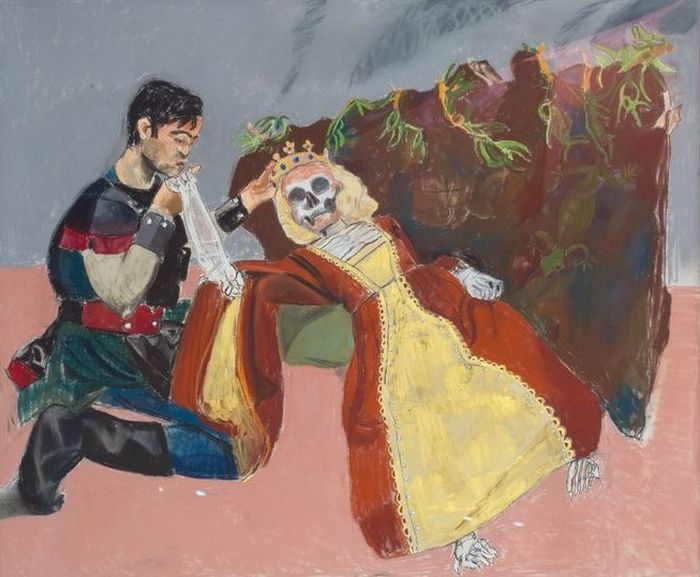
When walking into the Dome at Murray Edwards college, one of the most noticeable artworks is Inês De Castro, painted by the late Dame Paula Rego. The painting depicts the skeleton of the dead queen, dressed in finery and wearing a crown, whilst her King kneels beside her and kisses her hand. Though commissioned by the college, the painting contains many of the elements typically present in Rego’s work, such as femininity, violence, and folk themes from her native Portugal. Her works maintain pride of place in the Women’s Art Collection, but their reach extends far beyond the college grounds.
Born in Portugal in 1935, Rego decided to become an artist when she was 8, and was later sent to England for finishing school. She went on to become one of Britain’s most successful artists, exhibiting with the London group alongside David Hockney and becoming the first ever Associate Artist of the National Gallery in London. As her artwork reveals, Rego was not only concerned with politics and violence (particularly concerning women), but also folklore and myth. Real issues, such as women’s rights and particularly abortion, are often portrayed through the prism of folk tales. Reality and mythology are uncomfortably welded together, creating pieces that disturb and unsettle, rather than cushioning or providing an escape from the issues at hand.”Born in Portugal in 1935, Rego decided to become an artist when she was 8, and was later sent to England for finishing school. She went on to become one of Britain’s most successful artists, exhibiting with the London group alongside David Hockney and becoming the first ever Associate Artist of the National Gallery in London. As her artwork reveals, Rego was not only concerned with politics and violence (particularly concerning women), but also folklore and myth. Real issues, such as women’s rights and particularly abortion, are often portrayed through the prism of folk tales. Reality and mythology are uncomfortably welded together, creating pieces that disturb and unsettle, rather than cushioning or providing an escape from the issues at hand.
I wrote this piece after Dame Paula Rego, who was an honorary fellow at Murray Edwards College, sadly passed away in June 2022.
Read the full article here: https://www.varsity.co.uk/arts/24067



 Esmé Kenney
Leave a comment